
Battery storage for keeping more of your own electricity.
A battery stores spare solar generation from the day and releases it in the evening, when most households use more. Solar and battery installations are also currently zero-rated for VAT, a relief that runs until 31 March 2027.
Free and no obligation. Payment options available on qualifying routes.
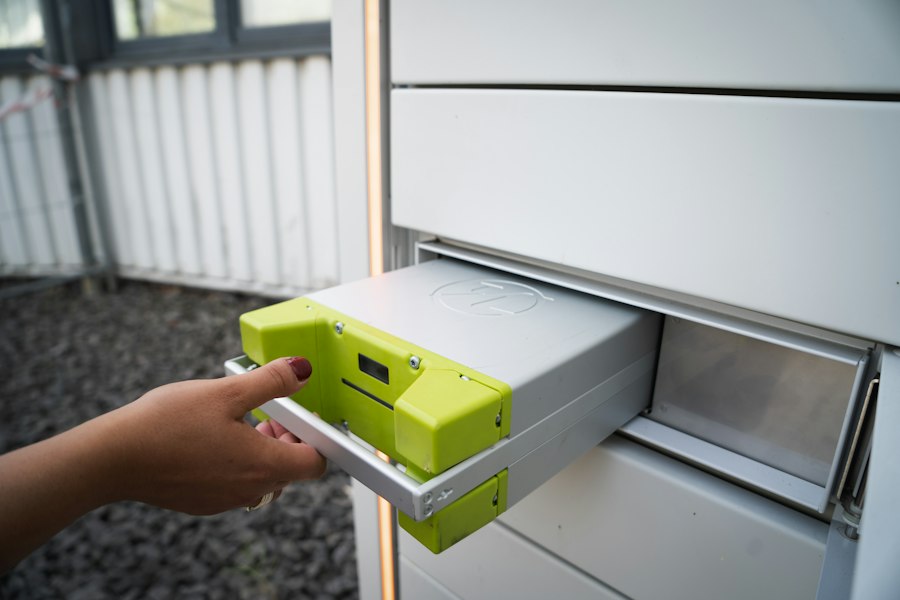 A home battery storage unit
A battery can go in with new solar, or be added to panels you already have.
Designed with new panels, the inverter, battery and array are specified as one system. Added to existing solar, a battery usually goes in without replacing the panels, once the inverter and set-up have been checked.
A battery can also be charged from the grid overnight on a cheap tariff to cover the dearer hours. Payback is usually quicker alongside panels, but it is worth asking about if you have none.
Battery size follows the household.
Three Dorset homes, three different set-ups. The biggest array does not mean a bigger battery, and the smaller battery is not the lesser design. Each was sized to how its household uses electricity.
A household that is in all evening needs more storage than one that is out until six. Sizing starts from your own usage, never from a stock recommendation.
Getting more from your tariff.
On a time-of-use tariff, a battery can fill up cheaply overnight and supply the house when rates are high, and some can feed stored power back to the grid for payment through a Smart Export Guarantee tariff. We look at your tariff before suggesting either.
If the power goes off.
Most home batteries will not run the house during an outage unless the system is set up for it. That depends on the battery, the inverter and the wiring, so say early if backup matters to you, and the proposal will state what is included.
Battery brands available include Duracell, Fox ESS and Growatt, and Tesla Powerwall on certain projects. Most modern units come with an app, so you can watch what is being stored and used.
Understand the system first. Choose how to pay second.
Once the price is known, compare paying outright with the finance routes currently available, including qualifying no-upfront-cost routes and selected short-term 0% offers. A battery can sit inside the same finance route as a solar system where qualifying options exist, or be priced separately if you are adding one to existing panels.
Finance is subject to status, affordability and lender approval. The installation team behind Dorset Solar acts as a credit broker, not a lender. Asking about payment options is not a finance application and won't affect your credit file.
Common battery questions.
Is a battery worth adding?
Worth depends on when you use electricity. Where most of it is used after the panels have wound down, a battery keeps daytime generation that would otherwise go to the grid for very little. The proposal looks at your own pattern.
How long does a home battery last?
Warranties on home batteries typically run for around ten years or a stated number of charge cycles, whichever is hit first, and many outlast them. Your proposal gives the exact terms for the product chosen.
Where does the battery go?
A spot near the consumer unit and inverter keeps cable runs short, so it is usually a garage, a utility room or an outside wall. Older stone homes with thick walls or little spare room are settled on site.
Where the battery fits in the wider plan.
Solar Panels
The generation that fills the battery. See solar installation in Dorset →
EV Charging
Stored power ready for an evening plug-in. Check EV charger options →
Review your property
Tell us a little about your home and what you're considering. We'll use it to review likely suitability and the next step.
Free and no obligation. Asking about payment options is not a finance application and won't affect your credit file.
No obligation to proceed. If the property looks suitable, a member of the solar team may contact you to clarify the details before a proposal is prepared.